Just funny

For those who don't get the point: the picture on the left is a famous picture from the Soviet era (and says "no" in Russian). On the right is the new president of Russia, Medvedjev.
For those who don't get the point: the picture on the left is a famous picture from the Soviet era (and says "no" in Russian). On the right is the new president of Russia, Medvedjev.
The most popular beer in the US is light beer. Bud light, Miller light, Keystone light, whatever. I am surprised by this to say the least. US has their own quality beer too, I've had plenty. But for some reason it's not popular.
My guess always was that it's because it's just people feel it's responsible to drink "light" for the same reasons they drink Coke Light or Diet Pepsi. But now I'm having doubts:
I saw this beer being advertising on a billboard next to some highway. They advertised this by "only 99 calories!". This is appalling. It's like people don't get what beer is. It's the same as advertising a book by saying "only 99 pages!" or "this book has plastic pages!" - totally missing the point what the books are about.
My understanding is that people here start drinking light beer when they're in college - because it's cheaper than any other kind of beer. And then they get used to it. And then they think that's what beer is and continue buying it. We need a cultural revolution. Some company that makes quality beer should develop a cheap, yet quality beer targeting students and teach them what a beer really is.
Budweiser light even says that they are the world's no.1 ranked beer in the world beer championships. I couldn't believe it at first, but then I saw that in the small print it said "in the American light beer category". Of course. No good beer competes in that category, so winner or not, that doesn't mean anything. Light beer is just wrong.
Alustasin internetiturunduse, elustiili valiku ja elufilosoofia küsimuste üle mõtiskleva ja nõu andva blogi.
Kae siit: internetmarketing.ee
I'll arrive to Estonia on the 4th of June and I will stay until the middle of September. See you soon.
One week from now the Panama-chapter of my life is getting over. It's been a different kind of experience, one that I am very grateful for. I will miss Panama. It is the most beautiful place I've ever lived in, and ever visited. The natural beauty is just amazing here. Parts of Panama are as close to paradise as I can imagine. The photo I've included in this post is what Panama symbolizes for me the most. I was doing some reflection on what I gained from this experience, and here are the top things:
Cultural lessons / widening my horizons
I had never been to Latin America before, so this was definitely jumping into the unknown. And when you go out of your comfort zone, that's where the learning begins. I have learned new things about the human kind and the way life can be. Here it is a lot about enjoying life, the community and party. The life here is more about enjoying the moment than worrying about the future. In the western world you hardly know your neighbors, here that would be really weird. They haven't lost this community-feeling here, and I hope they never do.
Coming from Estonia where people are not very expressive around strangers and in public places, it's the total opposite here - and that has been very refreshing. I never did get fully used to the noisiness of the people, the ultra loud music and non-stop honking on the streets. Here sometimes talking and yelling are almost synonyms. I still prefer the more quiet atmosphere, I guess it's hard to shake off your cultural background in that sense.
Spanish language
Speaking a foreign language is one of the most important skills a person can have. It is not only about being able to communicate with other people, it is also about discovering the miracle of language as a whole. Some languages have a better, more precise way of communicating a particular phenomenon of life. I think the more languages you speak, the better you can relate to life in a way and expand the way you think.
When I came here I hardly spoke any Spanish apart from 'hello' and 'how are you'. I am not fluent today either, but I can get by pretty well. The reason why I am not 100% fluent is simple - I didn't exactly integrate into the Panamanian life. Most of the days I still spoke way more English than Spanish. As I was self-employed, I didn't work in a Spanish-speaking environment either. Nevertheless, I managed to pick up a pretty decent level of Spanish and I am sure my Spanish-skills will enrich my life for years to come.
Becoming an entrepreneur
While my experience in Panama was less about cultural involvement and integration than I initially planned, it was a lot more about personal development and investing in myself.
I came to Panama working for somebody else. Luckily they ran into financial difficulties and couldn't pay my salary which forced me to look for alternatives. I arranged many job interviews, but due to not speaking Spanish at the time, asking for too much money (in Panamanian standards), and labor laws (a company can't have more than 10% foreigners in the staff) no one hired me. What I did find out was that the skill set that I offered was very much needed. I saw the opportunity on the market and I seized it.
I started my internet marketing company and was profitable almost from day 1. I landed several of the biggest companies in Panama as my clients + a few small ones and I was all set. Only after operating a few months I already started to reject companies wanting to be by clients as I couldn't take on any more jobs. I also don't believe in over-working and slaving in the name of making more money, so I never worked more than 30 hours per week. What's the point of making money if you can't enjoy it?
Studies conducted on happiness level of people state that self-employed people are generally happier than people working for somebody else. This couldn't be more true in my case. I've never been happier with my working conditions, I have a reasonable boss (me!) and I have the full control over when I work and what I work on. I don't plan to work for somebody else ever again. In fact, now that I have got the ball rolling, I have a myriad of ideas for new business ventures, and some of them will be launched very soon.
I think the impact on one's quality of life through relying 100% on yourself for your income is very powerful. Almost anyone could have the kind of life they want and have success being self-employed given the right tools. It is one of my short-term goals to provide people with such tools.
Why am I leaving?
While it has been good, I need something else. I've been living "temporarily" in different places for 3 years now. I feel that I need to set up a base camp or two, where I can always return to and that is mine. I love traveling and getting to know different cultures, and I will do it again and again (my list of places to visit and to live in is pretty big) - I just need to stay in one place for a couple of years and get some stability.
We didn't choose Panama to be this place because it lacks on few fronts that are important for us. We didn't fall in love with the Panamanian people (with some strong exceptions naturally) nor food either. Certain everyday things I have gotten used to and want in my life are at poor level in Panama, and it's the little things that make your world sometimes.
So what next? I'll spend the month of May in Austin, TX and June-August in Estonia.
A while ago I had a post about Sarah's experience in a remote jungle village in Ngobe-Bugle (northern region of Panama). That was the beginning of something big. Now Sarah is working with the indigenous women of that community to empower them, help them make a living and support their kids and revive the art of making kras.
The women in the Ngobe community are making the most amazing handicraft - handbags made out of plant fiber (they call them 'kra'). It takes 2-3 months to make one bag. The art has been around for thousands of years, and now Sarah is helping the women to take this jungle treasure to the world.
She started a blog where she is writing about each step of setting up this venture. It's really cool, and it's a great way to peek into the journey of a social entrepreneur in the making.
Link: Bag Quest
Yesterday I watched a documentary called Zeitgeist, recommended by a friend quite a while ago. I wish I had seen it sooner. It is a truly thought provoking movie you just have to watch.
It is about religion, the US, European Union, the grey cardinals behind the scenes and the world order in the wider sense. After seeing it so many things I witness in this world make more sense, and so many more questions arise. I would love to discuss this with you.
You can watch it at this address (it's free):
http://www.zeitgeistmovie.com
P.S. Skip the first 13 minutes of the movie which is boring and quite bad bla-bla intro that doesn't fit the rest of the movie.
Just got back from Cuba, where we spent 5 days. It was amazing. You can fit a lot of experiences in that short period of time when you're in Cuba.
Cuba certainly has a reputation, and we were not sure what to expect. We got on the plane and started the trip like any other. Our first experience that showed us this country is something different was already in the airport. Sarah went in first (just in case as she's US citizen and as everybody knows these 2 countries are not the best of friends, so we wanted to make sure I'm there in case she gets in some kind of trouble) and she was asked if she's alone. She pointed at me and said we're traveling together. Everything went all right, and it was my turn. The immigration check lady examined my passport very carefully and didn't believe really it was me on my passport photograph. After spending what seemed like too long time with her, she let me pass. In through the first door and two guys wanted to check my passport again. And as we were walking towards the exit, both of us were approached by a man in uniform and we were interviewed, separately. Have you been to Cuba before? What are you gonna do here? After the interview they took our passports and discussed it 5 meters away from us in a group. What was causing them concern, we don't know. We waited for like 10 minutes, got our passports back and were sent out with words 'Bienvenido a Cuba'.
First thing - exchanging money. We knew before that when exchanging US dollars Cuba charges you additional 11% commission, so we had prepared and bought euros. We got a bunch of Cuban Convertible Pesos (CUC) and were set to go. A thing to note here is that Cuba uses 2 currencies at the same time: national pesos (for the Cubans) and convertible pesos (for the tourists). 1 CUC ~ 1.1 USD. In the touristic part of Havana the prices are in CUC, other places in national currency. Cubans have basically no way to get convertible pesos and hence they are denied from accessing a wide range of restaurants, bars, services and goods. Some locations have 2 price lists, and tourists are being charged in CUC and made to pay a much higher price. Conversion rate between the national currency (CUP) and CUC is about 24 to 1.
The airport is some 20 km away from the most important parts of the city, so we got the first glimpse of the country through our taxi window. First obvious things you see are the old Russian cars on the streets (mostly Lada 04...07 and Moskvich) and even older US cars (from the 1950s and before): they formed more than half of the cars on the street.
Second thing: huge billboards next to the road filled with propaganda. "Viva socialism!", "Che - example for us all", "The plan of Bush: destroy our livelihoods, take our homes and crush our dreams. Luckily we live in free Cuba", "Bush is a terrorist", "Building up our villages" and so on. The billboards carry mainly 3 types of messages: 1) Long live heroes like Che Guevara and others 2) Long live socialism and communism 3) Bush and the US are really evil. The latter theme was also evident in the city on smaller posters.

 So it seems Cuba has a 'war on terror' campaign going on too, only the enemy is different.
For me it was in many ways like a flashback to the past - Soviet Union and its propaganda machine. Brainwashing was an important tool of the communist regime there, and still is in Cuba.
Most of our time was spent in Havana - it's huge (population over 2 million) and has lots to offer. The best attraction by far - the Havana Viejo, the old town. This part of the city has amazing colonial architecture, so when walking around you're in constant awe. It is by far one of the most beautiful cities I have ever been to. Spain had invested so much in it, probably they never thought they have to give it away. Just take a look at some of the pictures:


True, a lot of the buildings have not seen a repair job for 5 decades and are collapsing. It is sometimes sad to see people living in those magnificent buildings and treating it like an old shack. I wonder if the people living there appreciate the buildings and Havana Viejo, or they curse that they have to live in that old piece of s... and dream of a new condominium. Or maybe I'm wrong and they just cannot do anything due to their economic situation. Once the current regime is gone, the capitalism will do it part I'm sure and Havana will be one of the most expensive places for real estate - and unfortunately the native Cubans will most likely have to move to suburbs or something.
Cuba is a mix between Soviet Union, European high culture, Latino lifestyle and 1950-s United States. It is totally unique. In many ways, Cuba has remained stuck in time. Due to the trade embargos they still drive the cars that were on the streets before the revolution, or the ones donated by the Soviet Union. They are still in the communist restrictive regime, even though there is no communist Soviet Union anymore.


The city is very safe with almost no violet crime. We heard twice from Cubans that one third of the city population are either policemen or on police salary, which makes the city very safe and no one dares to do anything. Pickpocketing and scamming are there, but can be avoided.
Prices
My first surprise regarding the prices in Cuba started when I was looking for a hotel to stay in via internet. A large majority of the hotels are over $100 a night - and I thought it's gonna be a cheap trip. And quality and price don't go hand in hand necessarily. So many hotels I was about to book had horrible reviews about bad customer service, stinking rooms and moldy bed sheets.
We still managed to find a decent one, although basic.
As the country has 2 currencies, they can drive up the prices for tourists without affecting the life of the citizens. It's a central planning economy and there is no such thing as a private enterprise, so pretty much the price level has been set by the government. I'm not sure how much a particular institution has a say about the prices they charge - all the money ends up in the same wallet anyway (the government's).
A great deal of restaurants charge you way more than the food is worth. Havana cannot really brag with culinary expertise as the food is usually pretty average. The drinks can be acquired quite cheap, we had our cheapest Cuba Libre for $1.65 and paid as much as $6 for a daiquiri in the Ernest Hemingway's favorite bar (although there were more than 1 bar that claimed to be one, but that's very possible considering that he was an alcoholic). A beer ranged between $1 and $2. As Havana is the birth place for Cuba Libre, Daiquiri, Mojito and a wide range of other coctails, we made sure we try them all from different places to know the real ones.
They do nickel and dime you a lot in Cuba, and it can get as expensive as any European capital. Cigars
Cuban cigars - or Habanos as they are called - are naturally world famous. What I didn't know before is that they are a luxury product also in Cuba. The price is out of reach for most Cubans. The best brand in the world is Cohiba and their best cigar Esplendido - which Fidel himself smokes - costs about $20 each. A box of 25 is available at national tobacco shops for just under $500. It costs way more outside of Cuba.
We visited a tobacco factory and saw how they're made by hand. It turns out that all of the Cuban cigars are made from the same tobacco - only the leaves are sorted according to the quality. The best quality leaves made the best brand naturally. Cuba boasts that they have the best microclimate in the world to grow the best tobacco to produce the best cigars. We bought a bunch too and smoked at least 1 a day. I'd smoked cigars before and I must say that the top quality cigars really are much more enjoyable and smoother in taste. There is another industry that is as big as the cigar industry (or perhaps bigger) and that's fake cigar industry. On every corner there is a guy that says 'pst! want to buy cigars?' and then they share a story how their brother/uncle/father works at the factory and they offer out-the-back-door cigars for a much lower price. In most of the cases, it's fake stuff. They sell cigars made out of banana leaves and what not. I read stories of how some people's cigars even exploded. Ignorant tourists how know nothing of cigars and are tempted by the cheap prices get cheated all the time.
The conmen are very good too. Here's what happened to us. We were walking and I accidentally bumped into somebody going the same way. He apologized and made small talk - while looking and acting totally normal. He asked the usual questions like how do we like Cuba and where are we from (many people spark up spontaneous conversations without selling anything). Once he heard I was from Estonia his face lit up and he said 'Wow! I'm going to Estonia end of March!'. He explained how he was a conga drum player and today is a special day for him as it's his 11 year wedding anniversary. He told us he is giving a concert the same night at Buena Vista Social Club and if he want, he can get us in for free. We said 'great!' and he invited us for a drink in a nearby bar. Now it might all sound fishy already - but you have to understand that this guy was very likable, easy-going, and very natural. He told us how he likes music and loves his job. He danced salsa with Sarah and ordered a round of mojitos. He wrote us an invitation to the Buena Vista Social Club, took our names and said he will make reservations for us, so we can go for free. Then somehow the discussion went to life in Cuba and cigars, and he told us how people sell banana leaves and how people get cheated and so on. But how at the same time Cubans can get cigars cheaper and he can arrange this for me. He emphasized how he is doing it as a favor, to help out a friend as friendship and honesty are so important for him. He said musicians don't make any money in Cuba and he will get a commission when we buy cigars through him, so he can make extra living. He said the price is $200 for a box of Esplendidas, but since he likes us he can get it down to $160. The more he talked about it and the more he pushed, the more suspicious it seemed, but we couldn't be sure - maybe he was telling the truth. Then we saw how another tourist couple came in with a Cuban who was writing them something that looked like an invitation to the club. A few more hints like that, we were out of there. In the end we'll never know, maybe it was an honest guy, but sure seemed like a well-polished scam machine. He was very good.
An example how people fall for this kind of scams: we met a guy in our hotel who asked us for a loan as he had been scammed out of his money. Apparently he stumbled upon somebody who claimed he can exchange his dollars for a better rate (without the government 11% commission). Naturally, the crook took off with the money never to be seen again.
Scamming tourists out of money is by far the most profitable way to make a living in Cuba. Doctors and lawyers make $25 per month. It's easy to see the benefits of making money off of tourists.
Regarding out-the-back-door cigars: they do exist, but you have to be careful to find them. Later we found out from our Cuban friends (students at the University of Havana) that people caught stealing from tourists or scamming tourists go to jail for 15 years. So the trick is that if somebody invites you to their home and you buy cigars from there, they know and you know they have no escape from you. If they sell fakes, you can get them and the fear of police is great. We got a good deal too from a hotel security guard. He gave us the best guarantee: we know where we works, he gave his work schedule, name and everything. He let us try to goods, touch them (we learned how to distinguish real cigars from fakes too) and we liked the guarantee. Just in case we bought also the same type of cigars from the national shops to compare the difference. The risk I took was worth it, I got the real stuff for a really good price. If anyone is going to Cuba, let me know and I will tell you how to get in touch with that guard.
Where everybody knows your name
On our second day, we're walking around the neighborhood near our hotel. Several people approached us and just made conversation: where are you from? are you looking for something particular? The conversations were casual, nobody was selling us anything. What nice friendly people these Cubans are!, we thought (still do).
The weird thing was that the first three people that made conversation with us all started with the same line: I saw you arriving yesterday, you stay in hotel Deuville, right? When the first guy said that, I though he paid attention what was going on. When 2 more guys did the same, it already seemed a little creepy.
We kept walking and went into a pharmacy to see if they had some nose medicine (Sarah was having trouble with her nose). As most of the shelves were empty, they also didn't have anything for the nose. When leaving the pharmacy, another dude showed up and asked what we need. We explained the stuff and he gave directions to another pharmacy. We walked toward that direction and one more guy shows up and said he works for the security in our hotel and he saw us yesterday, he can take us to the pharmacy. Now while he might have been telling the truth, we also considered the possibility that he will lead us to a hidden corner where a gang is waiting to rob us, so we declined. We keep walking and another guy approaches and says 'hey I saw you yesterday, you have a problem with your nose, you should go see a doctor who will prescribe the correct medicine for you'.  And he wanted to take us there. He kept explaining why this is a good idea and how the doctor lives nearby. We refused, kept going and one more guy came up to us and said 'Hey you're from Slovenia right? You have a problem with your nose'. I just couldn't believe how fast the news had spread. It seemed that everybody knew we came yesterday and we have a problem with the nose. I asked how come everybody knows who we are? He replied it's because we're both blonds, and so we stand out. Maybe, but out hotel was full of Europeans, some of them blonds. While walking back to our hotel, an older woman approached us and said she lives right here and has some cream we can spread on the nose - so if we want she can go get it. As we didn't feel threatened by the old woman, we kind of believed more that these people really were perhaps trying to help. But in the end we'll never know.
The dark side
When seeing the happy friendly Cubans, the amazing architecture and enjoying the gorgeous weather, it's easy to start believing Cuba is the most awesome place. We talked about wishing to meet some real Cubans to ask questions from, somebody we could trust - and the opportunity came.
We were walking towards the Plaza de la Revolucion and made a stop in the university (another amazing location). We rested our feet while sitting on the university stairs, and two guys came out from a building and sat on the stairs as well. For a while they spoke to one another, until they showed some curiosity towards us. We started to talk, and they told us about the real Cuba. When talking to Cubans I was never sure whether they're "one of them", heavily brainwashed or they know the regime sucks. These guys, history students, were very aware. They dreamed of traveling, but as Cubans they are not allowed to leave the country. "Cuba is an open prison", one of them said. You cannot even leave the city you are resident of. If you want to go visit your relatives in another location, you have to apply for a special permit and have to specify exactly where you will stay and for how many nights. When they heard us explaining about where we have been in the last years and what are our plans, one of them asked: "so if you want you can go to Italy, France or wherever?" When learning the answer is "yes", he looked at his friend and said "that is freedom".
Cubans are kept in information isolation. They have no access to internet nor satellite TV. They can only read government newspapers and watch 4 local TV channels (Fidel 1, 2, 3 and 4). It is illegal for tourists to bring in non-fiction books, magazines or newspapers. The university curriculum and what is being taught is manipulated and reflects what Fidel wants people to think. Still they knew it was all a lie. There is internet available in the hotels, but Cubans are not allowed to enter hotels. Our hotel room had CNN and other channels, but no Cuban ever sees those.
I asked them if they think the government will ever change, they said yes, maybe in 20 years. People are not happy with the way things are, but resistance to the regime will get you in jail for 20 years and nobody wants to be the first.
People escape when they can, as just recently happened in the US when 5 Cuban soccer players took off during the Olympic Games soccer qualifying tournament.
"In Cuba it's not capitalism, it's not communism - it's Fidelism", one of them said. They thought highly of Che Guevara who they said cared for the people and with his departure everything went down the hill.
Cubans are paid ridiculously low salaries, nobody can ever save money. They are deprived of so many goods - even beef. Beef is for tourists. They cannot take part of the best Cuba has to offer as they don't have the convertible pesos. We bought them a drink in a nearby bar and we were charged tourist price -$4 per drink. They rolled their eyes when they heard the price and one of them said 'had I known it costs so much I would have taken the money, as I could have bought food for many days'.
Their stories were sad and I could feel their pain. I wanted to do something for them, help them somehow, but it's the regime that is the problem.
Here's me with our new friends:
The beauty
Cuba is a gorgeous tropical place. The weather was amazing at all times. We also took the time to go to the beach. Beautiful beach was available just outside the city. We enjoyed drinks from coconut, swimming in the teal color water. A policeman was walking up to each person and asking their nationality. Not sure what was the reason, but just in case these moments we claimed both to be from Estonia. Who knows, maybe they were looking for terrorists from the US.
In any case, I would recommend for anyone to go to Cuba. If not for anything else, it's worth the experience of having a Cuba Libre while smoking a habana in Havana old town.
How are you doing, Peep? I'm doing great, thanks for asking!
Every single day I only do what I want to do. I sleep until 9 usually and wake up because the sun fills my bedroom. I'll proceed to brew some tasty coffee grown right here in the highlands of Panama and I eat yogurt that comes from delicious Panamanian cows. I enjoy the view of the Pacific Ocean from my rooftop pavilion and look at the pretty blue sky.
Every day I ask myself: what would I like to do the most today? This is a privilege most people don't have, and I am quite aware of it. My life is like that by design: I painted a picture of a life where only I make the decisions about my life and where I only do what I want. And then started to live this dream.
About a year ago I made myself a promise to never do anything again that I don't like. I broke this promise once (I'm just a mortal too), but it was a good lesson and taught me that I need to keep this promise to really enjoy life.
And you know what - when you stop doing things you don't like and only do things you enjoy - life is really good. In fact, it is fantastic. You can challenge me and tell me 'so that must be really boring because life is about challenges'. My answer is that no, in fact it is interesting as hell as I only do interesting things, and my life still is a challenge because I still have goals I want to achieve and I never stop growing.
So how is it that I get to live this kind of a life? A key reason is that I stopped working for other people.
The way I see it there are quite a few problems with working for other people (having a job). Sure, I used to work for other people too. While at times it was fun, I learned new things and met new people, I always had a boss. I had to comply with the rules of the company. I had to get up way too early in the morning and go to work and do what was expected of me – by other people. A company by definition is designed to maximize the profit - and who gets right profit? It's not you, the employee. You are just a cash cow that is milked to make money. Ok, that might have been too harsh, but think about it. Even when your boss calls you 'an asset to the company' and that might be true, then what does that mean, being an asset to the company that is? You've guessed it. You make more money to the company owners than other employees. If they'd lose you, they will make less money... so you're an asset. Congratulations!
And what's in it for you, dear employee?
Even when you do get paid a decent amount, you only make money when you work. You only get paid for the hours you go do something at work. This very well means that you will almost never get to live the life on your terms. Say you have enough cash to take a trip to your dream destination. Can you go whenever you like and stay for however long you like? No. You have to ask permission from your employer. You have limited amount of vacation days. You have so many other things you want to do with your days off as well, so basically chances of you taking your dream trip for 1 month just when you feel like it seems almost impossible.
So you’re putting all your energy into something where you have to do things for other people, take orders, play by their rules and they get all the money. That doesn’t seem fair to me.
Luckily, there is a better way - go solo.
I am launching some cool projects soon that will make people happy. I will teach them exactly how to achieve the kind of lifestyle they only dream of right now. Spanish-speakers and Estonians will the first ones to benefit, as Secretos de Mercadeo en Internet and Internetiturundus ehk kuidas teenida raha projects will be released in the coming months.
March is an exciting month for me. Next week we're going to Cuba (to visit it while Fidel is still alive) and end of the month we'll have visitors coming here to Panama.
Can't wait.
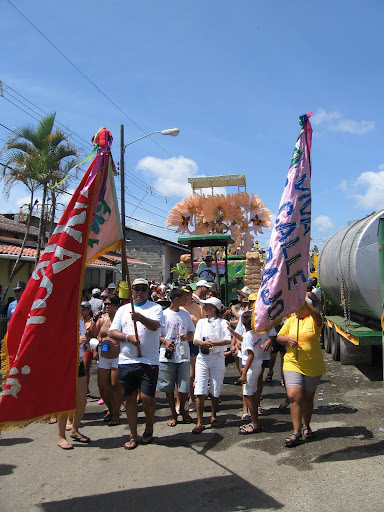 The first 5 days of February was Carnival - the most important holiday in Panama. Everybody knows the carnival in Rio de Janeiro, Brazil, but there are big festivities as well in other countries, including Panama. Every country has their own story and has had their own evolution, and carnival in Panama is like no other.
As I mentioned, it is the most important and most anticipated festivity in the country. Some people save money for a year just for the carnival. It last for 5 days (all work-free), all days following the same routine.
The roots of the carnival here lie in the history. The way the cities were built here (by the Spaniards) followed the same model: there was a center square with a cathedral, and a matrix of streets surrounding it. The rich people lived in the upper part of the city, the poorer people in the lower part. Nowadays the division is not as clear naturally, but the concept remains. The carnival is essentially a (friendly) competition between the two: upper street (calle arriba) and the lower street (calle abajo).
The centerpiece of the carnival are the Queens (las reynas). Both, calle arriba and calle abajo have their own queen. So the competition is who has the prettier queen, which street has fancier fireworks, which queen is accompanied by a better band of musicians, who has the better party.
Every city in Panama has their own carnival with their own queens. The queens are chosen by a special committee many years in advance and they undergo a rigorous training to be ready to be the queen of the carnival one day. The queens are usually between the ages of 18-22. It is a great honour for the family if the their daughter is the queen, and therefore no money is spared. Some families save years for the day and spend hundreds of thousands of dollars for the carnival: for the training, for the outrageously expensive outfits, the wagons/cars (don't know how to call them) used during the carnival that carry the queen and so on. The money that could be used to educate all of their children and grandchildren is spent on the carnival.
So what happens during the carnival is pretty much this:
People gather in the central square and surrounding streets with huge quantities of beer and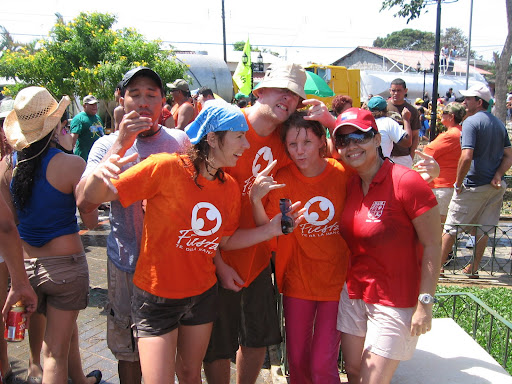 types of liquor already in the morning. Around the noon time the queens with their parties of princesses (other pretty chicks who walk before the queen), supporters (family, friends, fans) and a band of musicians (15-20 guys with brass instruments) start making the rounds around the square and surrounding streets. Each party has their own songs made especially for this year, and it's mostly gossip about the other queen. People cheer and watch the queens and their party. A special tradition is something called culeco - getting everybody wet. In the old days the water was carried from the river, now they use huge container trucks with water hoses for that. People really like to get soaking wet. I must admit it is useful - it's quite hot in the middle of the day in this time of year.
The queens make 4 rounds and leave. People continue drinking, chatting and mingling. Food vendors are everywhere. Every now and then there are firecrackers here and there. At the night time (10pm or so) the queens return, with much fancies outfits, cars and everything. There are huge fireworks. The queens make 4 rounds with their parties, people are ecstatic. Everybody is drinking and eating. At the night time people continue to party either at the same place, or go to clubs.
And the same stuff 5 days in a row.
Carnival is different in size and customs in every city in Panama. In the Panama City its more like the carnival in Miami (more like a concert). I personally went to a small town of Pedasi. The party was not huge there as the city is small, and the queens and their outfits and stuff were not that fancy. The bigger the city, the more money is spent. The most famous carnival takes place in the city of Las Tablas, where we also went to for 1 night. Everything was much bigger and fancier over there. The downside for me was that the crowd was so huge that you barely had room to breathe. It was much more laid back in Pedasi.
Something worth mentioning is that we made a stop at the parents house of a Panamanian friend of ours, where we had dinner. They offered me some chicken. The meat was tough and it looked kind of different, so I thought is a bit old and dried chicken meat. Later they asked if I want to see the eggs of the chicken I just ate. The eggs looked like this: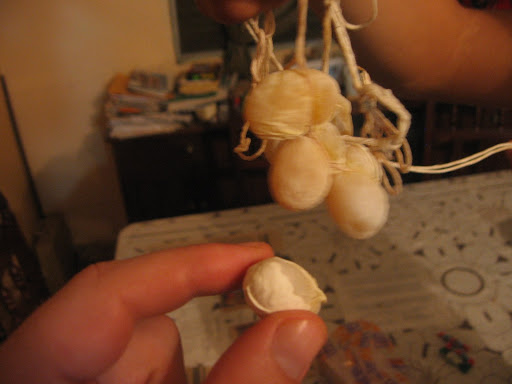
Turns out I ate the meat of ... iguana. Yes, a lot like chicken. The eggs were edible too, very salty tho. They boil the eggs, and then let them dry in the sun. And this is what they look like after being dried.
I don't have the photos and videos from the carnival in Las Tablas, but I do have it for Pedasi (you saw some above). Enjoy!
P.S. Tomorrow is my 2 year anniversary with Sarah. We're off to a paradise island. Catch you later.
Every country in the world has it's good things and bad things. I sure am enjoying the good stuff here. Two weeks ago I was again discovering the beauty of Panama, this time in the mountain regions. We stayed in the best hotel in David, Chiriqui (David is the capital of the province of Chiriqui), went to flower and coffee festival in a nearby city Boquete (which is a very popular retirement destination for Americans) and bought many beautiful flowers (orchids etc) and some tasty coffee which grows there plentifully.  But - there are some frustrations I'm having as well and why not share it with the world. First of all time. It's polite to be late here. Even 30 minutes late is okay. One time at a business meeting a guy was 2 hours(!) late. He mumbled something about the traffic and everybody was fine with that. I can't imagine being late for something 2 hours in Europe. I am personally very punctual, so it is especially hard for me.
A useful characteristic to have in Panama is patience. Things can take a long, long, looooooong time. And they think that's fine. I though Dubai had prepared me well to take it easy and go with the flow. Wrong! Still a way to go...
Promises. When somebody promises something by some time, it doesn't mean much. If somebody tells you "I have this thing ready for you, come pick it up", my first thought would be "aah, it's ready, I can go pick it up NOW". Here it doesn't mean anything like that. It means the guy has the intention of getting it ready. And it's not just me who doesn't understand this stuff, Panamanians get fooled too, and they're not happy about it. So if they're not happy about it either, why not start being punctual and keeping promises? Of course, there are exceptions and it doesn't apply to everybody.
The way things are organized. Panama is full of bureaucracy, stupid rules that don't make any sense but people follow them to the point. For instance in the government side: I recently renewed my visa and had to experience a very ineffective system. You stand in (a huge) line, go to counter A, get forms, fill them in, stand in line, make copies of the form, go back to the line to counter A, give them the filled form - but they don't look at the form, but interview you instead asking the questions on the form (which you have now 2 copies of). You pass the test, are given an invoice, go stand in the line for counter B, pay some money, go stand in line C and make copies, go back to the line to counter A. And I missed some steps. All of this took 3 hours. Could have taken 10 minutes, if only 1 person would have done all of that stuff.
Another place to see idiotism in action in any mall. First of all you cannot enter most of the shops while carrying any bags. You have to stand in line to put your bag away to a place where they keep bags (don't know how to call it) before they'll let you in. Everything you buy, you get a receipt for and when leaving the store you have to show everything to the security guard along with the receipt and then the guard takes out a marker does a check on the receipt. Why oh why? Just today we bought a small table. I mean we told a guy in the shop we want this table. He went to the backroom, got one in a package (not assembled yet). He cut the package open, took out all the parts and put the package together again. Additional 20 minutes gone. I understand that the goal is to make sure all the pieces are there, but if the package is closed since the factory, what are the odds its not okay? The he filled out 3 forms and we needed to sign 3 different documents. All for a small cheap ass table. On your way out of course the security guard hassles you and makes a big deal out you not finding your receipt immediately.
And naturally every item you buy is put into a separate plastic bag. So every time you shop you will leave with 35554 new bags. Yay for the environment. They will also tie the handles into a knot or staple the bag and the handle together so its really inconvenient to carry it around.
It is also very okay in restaurants to be waiting for your food for 1 hour, getting something you didn't order and then they just say 'aah, oops'. No apology, no money back, no free meal. Customer service is notoriously bad in the country. And another things really bad is the selection of goods availabale at the stores. Things for kitchen, livingroom, whatever are all very much overpriced and very low quality. Panamanians have a taste for low quality crap. It seems to me that all the crap from all over the world is sent here and is sold off for a high price. It's like this exporter's dream. The wine selection is great, but at least half of it is undrinkable throat-burning liquid. Panamanians drink it happily and make sophisticated faces and gestures while drinking it. In a fancy restaurant a waiter offer you to sample a $2 wine like it's the greatest stuff ever.
Shops are full of fake stuff. You can buy fake books (plastic or tin things that just look like books that you can put on your shelf to look smart), fake-wood vases and whatever. People decorate the front yards of their houses with fake stones (made from plastic, just looks like stone). A neighbour of ours, an amazing jewelry maker told us that any middle class American has better art at home than rich Panamanians). He has seen people throwing away vintage very expensive French kitchen set just because it was old. And you can buy some expensive fake plates and cups instead.
And - this country badly needs an emissions standard. Any car that can move, can drive around. Every 5th car on the street has so much black smoke coming out of them that it blocks the sunlight. I am surprised how half of the cars on the street even move. The public transportation buses (US school buses from the early 17th century, or at least they look that way) make so horrible sound that it's like the end of the world is coming. They are called 'red devils' by the locals cause not only are the big, ugly and noisy, but also very dangerous in the traffic as they are huge and drivers visibility is limited.
And the general loud noise everywhere bothers me. The too loud music, the non-stop honking in the traffic and people yelling real loud.
The funny thing is that once I will leave Panama one day, I will miss all of these things.
 Panama is a paradise. It has everything: the prettiest beaches you can imagine, pristine rain forests, mountains and hills, rivers and lakes, even 2 oceans. Everything grows here really fast. The temperature is near perfect (can get too hot and humid in some months). Sometimes when working indoors its easy to forget what a paradise I live in. But I do am grateful for being here.
Some snapshots from my life in Panama:
 I am back in Panama. A month in the States went by so quickly. Something that I always wonder about is how going from one country to another is kind of like going to another dimension at the same time - especially if the countries are far apart, with quite different everyday realities.
Life in Panama is unique and the everyday rhythm is different here. So is the US, Estonia and Dubai. Whenever I am in one of those places I feel like the other countries are so far away, like a distant dream. It would have been easy to forget all about Panama had I stayed in the US for a longer time. Now being back here Panama seems so cool and real, and the US seems to be in another dimension, with its people and reality.
The highlights of my trip were spending time with the people there and observing the holidays over there. I've written about Thanksgiving and I want to say something about Christmas too.
I find it quite fascinating how Christmas traditions are different in different countries. In some countries its the Christmas Eve (24th) that is the most important day, for some the Christmas Day (25th). In the US Santa Claus comes while the children are sleeping through the chimney and leaves presents in the stocking or under the Christmas tree. In Czech Republic is the Baby Jesus (Jezisek) who delivers the presents:
"Small children are not allowed in the room where the Christmas tree is being decorated. So, the parents decorate the Christmas tree, prepare all the presents and light the candles. The children are told that during the evening when no one is watching, the little baby Jesus, Jezisek, comes and brings the presents and the children don't really have any real idea about what Jezisek looks like. Then the grown ups ring a bell, slip out of the room, the children enter and there it is- in the darkness the tree is all lit up and the Christmas presents are under the tree."
In Estonia the presents are delivered by Santa Claus himself - directly to the children. Santa Claus comes by during the evening of the Christmas Eve, walks in the door and has a big bag full of presents. Everybody, children and adults equally, have to recite a poem, sing or dance to redeem their presents from the Santa. Preparing for Santa's coming is an important part of December as children are memorizing poems and songs. Nobody gets a present without doing something first - you have to work for your present.
Here is a difference I saw between the US and Estonian Christmas: in the US you don't have to do anything to get presents, thus the appreciation for the presents is lower. If you don't immediately like what you got, you throw it aside and run to open the next one. In Estonia the children appreciate the presents more because you had to work for them. At the very least, you pay more attention to it and try to figure out what you got and how it works. I might be biased, but I feel the Estonian version is better in that sense.
I see a parallel with money. You spend easily money that was given to you for nothing, and are frugal with hard-earned income.
Other than that Christmas was fun, warm and full of love and good food like I guess it is everywhere.
It was kind of hard to leave the US and the people there - it's always hard to leave I think - but it is so very nice to be back in sunny, happy and warm Panama.
Do you know yet what is your purpose in life? Are you living your passion?
I think living a life of purpose is a spiritual experience.
I recently revamped the The One Question website that provides spirituality information and helps you discover your purpose in life.
Happy self-discovery!
I'm currently in Austin, Texas - a nice change for hot Panama. Here the weather remind me of autumn in Estonia. There golden leaves on the trees, and it's cold. Didn't think it can get as cold in Texas, but what do you know. Now it's gotten better, but on the weekend it was around 6 degrees.
I'm staying in Austin for almost a month, going back to Panama after Christmas. So I get to experience the Christmas here too. So far the weather is stopping me to feel like Christmas (where's the winter?), but maybe it's too early. At least it's not like Dubai where I spent Christmas during a perfect summer weather.
I participated in my first Thanksgiving last week with Sarah's family. I'm beginning to understand why its so important for Americans. It's the food of course! Just kidding. (Although it was reaaaally good).
It's a strange feeling being back in the US. I spent 3 months here in the springtime and now when coming back it's a familiar feeling. The culture and surroundings here feel closer to home than Panama.
Anyways. Probably I'll report again once back in Panama to share my plans for the next half a year along with some Panama stories.
A real estate developer is destroying a highly disputed rare strip of rainforest in Panama City against government 6rders. We can stop them right now, we just need your voice. We need to tell the world what is happening, how unique rainforests are being destroyed in full view of public authorities who are are impotent to act.
Let's tell the world. Read about it here: http://www.crea-panama.org/deforestationnews.html
What you can do:
- blog about it
- submit http://www.crea-panama.org/deforestationnews.html to social bookmarking sites like digg.com, reddit.com and so on
- tell the members of press
The more we wait the more forest is being cut down. We can stop it now, we just need more voices on our side
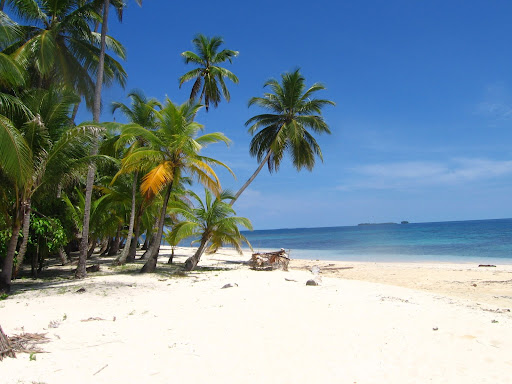 That's a picture I took 2 days ago. I have finally been to Paradise. It's the land of the Kuna people, indigenous tribe living on more than 350 islands off the coast of Panama.
As there was a long weekend here due to Independence Day celebrations, we had an offer to go to the Carribean side of Panama, to spend 3 days in the Kuna Yala territory. I am so glad we took it. I had heard of the beauty of the Carribean so many times before, but had not yet had the chance to see it for myself.
Kuna Yala (territory for Kuna people) is quite isolated - there are no proper roads to the area, no modern development. Internal flights from Panama City go there a few times per week, alternative is to take the dirt road across the mountains. We chose the latter one as that's cheaper.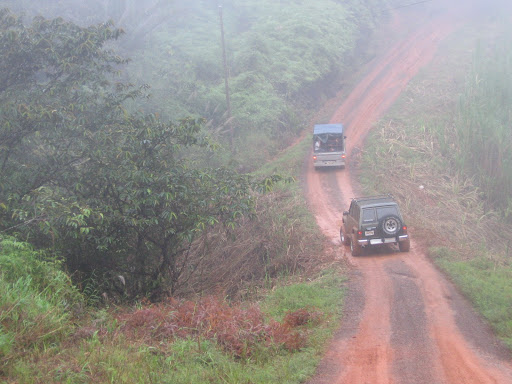 The road took us through rainforest and cloudy mountains. The road was so bad and muddy that sometimes I was astonished we didn't get stuck. Naturally we were driving 4x4 cars. Panama is gorgeous and it was a beautiful drive. Check out the video below that shows you the serenity of the rainforest:
At one point the road ended and the only way to continue the ride was to drive through a river - which we did. Never experienced that before. To my surprise it was easier than I thought, no water what so ever came inside the car. I recorded this as well:
Finally we arrived to a tip of a mountain were we saw the Carribean for the first time. Video:
On the coast there was a boat waiting for us ready to take us to a Paradise island. We passed many little islands and made a short stop to change the boat in one. The whole boat ride was jaw-dropping for me as I all of the islands were amazingly beautiful. This was also my first hands-on contact with indigenous people in Panama. Observing their way of life was a one of a kind experience, one that I am very thankful for. Kunas have managed to maintain the way of life their ancestors were living with only a few modernizations, like motors for the boats, gas cookers and sowing machines. Some of them that were involved with tourism had cell phones. Thats about it. The houses were made out of straw. All the clothes hand-made. Fishing equipment made from whatever resources available on the islands.
 Some of the Kuna people make their living by allowing tourists to live on their islands. They have constructed cabanas (huts made out of straw and palm branches) for people to sleep in, offer food and boat trips for a small amount of money. The islands itself are a paradise. We were destined to spend 3 days on one of such islands. This was ours:
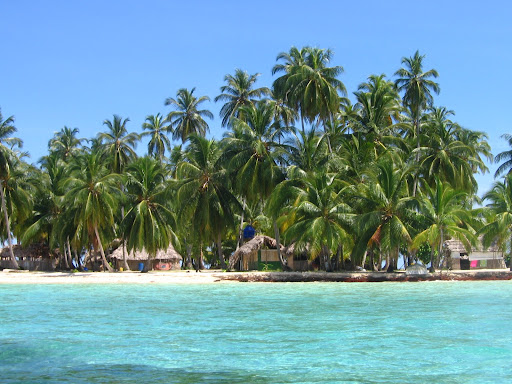 Yes, the water really comes in the prettiest colors: teal, light blue, green and white (because of the color of the sand in the bottom). We couldn't get enough of swimming. The water was totally transparent, perfect temperature and full of interesting "animals". Sometimes you could see a swarm of little fish (thousands!) swimming by, or some pre-historic fish-like things.
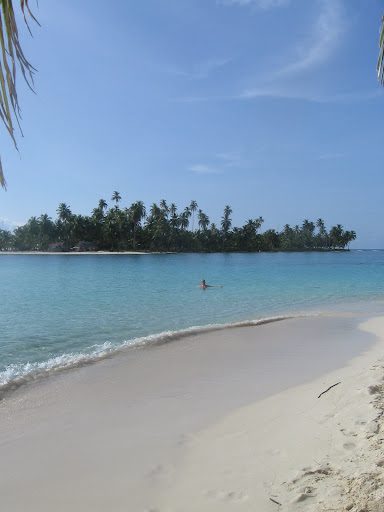 That's me in the water. As you can see, the beach and water are really crowded. Kuna Yala (also known as San Blas) is a true undiscovered gem.
Besides our own island we also got to see a different island (Isla de Perros) which is supposedly one of the prettiest around here (and it really was beautiful). It had no dogs, but it did have a cat. As it was the Independence Day of Panama, we went to see how it's being celebrated in a bigger Kuna village. There was a little parade and some performances by the school kids (yes, they have schools on the islands). Check this out:
We learned quite a lot about the Kuna people and their traditions. It's fascinating. The women are more important in the society, and families generally want to have more girls than boys. When young couples get married, its the boy who leaves his family and becomes a part of the girls family. When a girl reaches a certain age, she will have a coming of age ceremony that lasts for 3 days. In the process all of her hair are cut off and she never lets them grow long (only up to shoulders). Kuna religion has 2 gods: a man and a woman who are the beginning of all (like in the nature).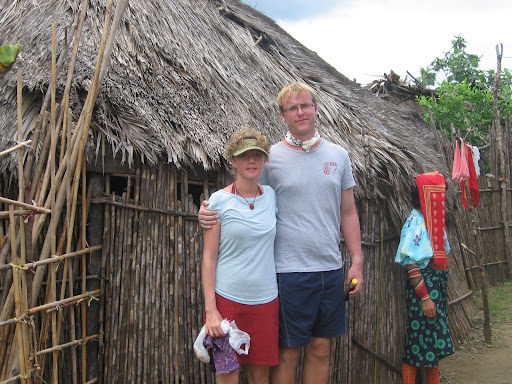
Our tour guide called Robinson (a Kuna) was quite knowledgeable of worldly things - he knew exactly where Estonia is on the map and happily showed it to everybody.
Among other things it was the first time I drank coconut water straight from a coco. I also tried to climb the coco palm and found its not as easy as seen on TV.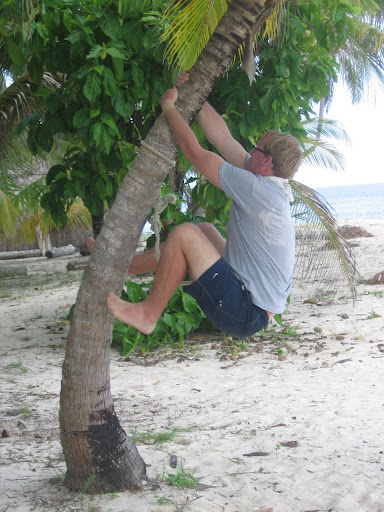 I also discovered how beautiful can Paradise islands be during the sunset. The mix of colors is quite astounding.
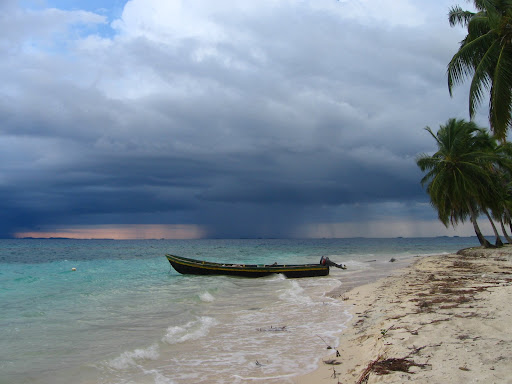 Anyways, when you come visit me in Panama, we can go there together too. So better start making your travel plans.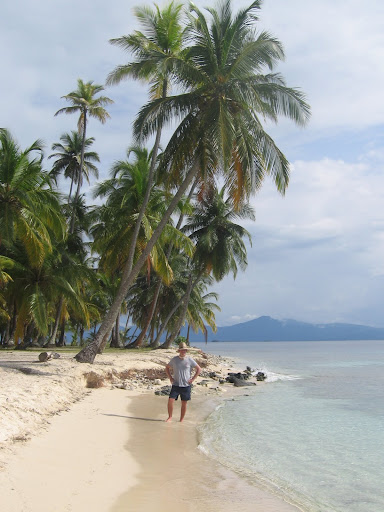
Check out all of my pictures from this trip: http://picasaweb.google.com/peep.laja/KunaYalaTerritory
As the Panamanian tourist visa is valid only for 30 days, we had to leave the country and decided to go to Costa Rica. We traveled to Costa Rica bus and the trip lasted for too long - 17 hrs. The only good thing was that we could admire the amazing landscape and cloud forests of Costa Rica rural areas. During the trip the bus stopped several times as the road needed to be fixed - constant rainfall (and the downpour of water from the mountains) had destroyed the road in many places. We had great plans for spending a week at a wonderful beach sipping great cocktails, but unfortunately it didn't quite work out that way. October and November are the culmination for the rain season which meant that it rained every god damn day. Most of our time was spent in the hotel. The good thing was that internet was available and we could work from the hotel, so time wasn't wasted.
When we looked for opportunities to go outside San Jose (the capital), we were taken aback by the outrageous prices of public transportation. A bus to the Carribean coast was $80 one way (4 hour trip)! So for the 2 of us a trip there and back would have cost $320. This must be the most expensive bus in the world. In Europe I could fly from North Europe to the Mediterranean and back for that money. Only later we discovered that there is another cheap bus company going to all the locations as well, but it seemed to be a well-kept secret that no white man should find out.
Average Costarican (in San Jose) seemed to be somewhat richer than average Panamanian - although appearance might have been deceptive. Prices in San Jose were higher than in Panama City with few exceptions (restaurants). A taxi driver told us that many Costaricans go on shopping trips to Panama City as clothes and other that kind of items are so much more expensive in San Jose.
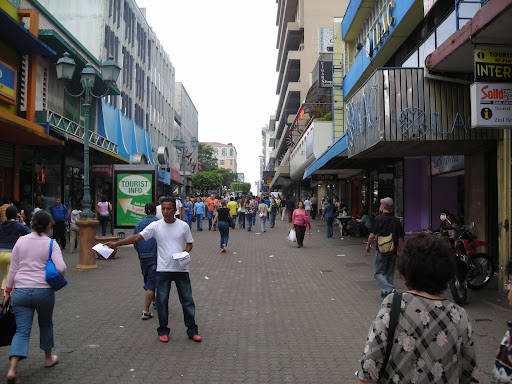
The city of San Jose was less impressive than Panama City, but seemed more safe. The city lacked the fancy old town that Panama has, although it had its old district with some pretty buildings too. The city itself was considerably smaller and easier to navigate. We saw so much more white people - Costa Rica as a tourist destination is way more popular. What I liked the most about San Jose that it had a proper city center with a walk-only street like most of European cities. Panama City doesn't have a city center (like Dubai) and I miss that.
Costa Rican Spanish was a lot clearer and easier to understand than Panamanian. We picked a difficult country to learn Spanish in :)
Now we've been back in Panama City for a week. Some updates of what's going on with my life:
The ethical company that I was doing some work for turned out to be not that ethical in its business practice. Sarah wrote about that in her blog, so I won't go into details here. As I couldn't rely on income from that company anymore, I decided to go solo. My initial research and talks with local people pointed out to me that there are wonderful business opportunities here in Panama. Right now, this is the place to be as all sorts of things are happening and now is the time to take advantage of this and build something great. I have many plans and I've started to execute them already. I started my own internet marketing company here and the future looks bright.
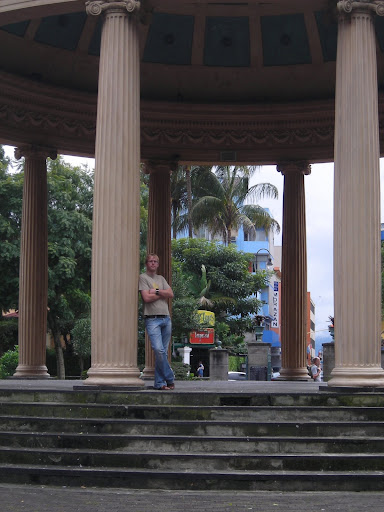
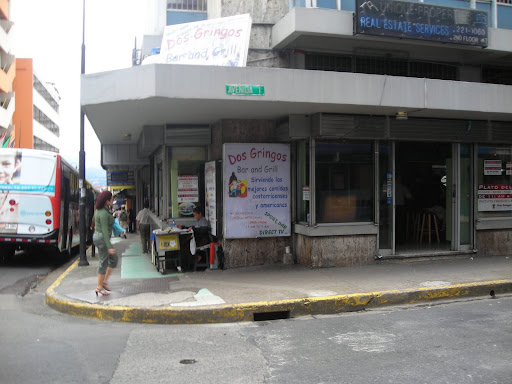
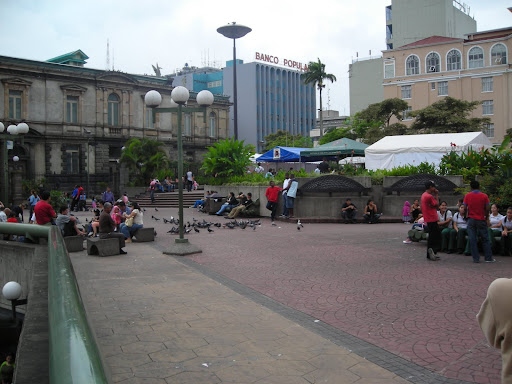
Some views of San Jose: